Compare
Fado hour or tuk-tuk and river?
An hour of live fado or a tuk-tuk ride through Porto with a Douro cruise: what each gives you, when each runs, who each suits, and why many visitors do both.
See open fado dates ↗Quick answer
They answer different wishes and rarely compete for the same hours. The tuk-tuk ride is about 50 minutes of sights by electric tuk-tuk, and its optional 55-minute rabelo cruise under the six bridges sails only in daytime hours, so it belongs to the afternoon. The fado concert is a seated hour of song, wine glass in hand, booked by date with its own start time. Pick the tuk-tuk to see Porto, the fado to hear it, and do both if you have a full day.
Side by side
| Fado concert | Tuk-tuk and river | |
|---|---|---|
| Length | One hour | 50 min; 105 with cruise |
| When | Start time per date | Cruise in daytime |
| You mostly | Sit and listen | Ride and look |
| Included | One glass of wine | Ride; cruise if chosen |
| Guide | Short talk at end | Live guide |
| Wheelchairs | Not suitable | Not suitable |
| Cancel free | Until a day before | Until a day before |
The short answer
If your time in Porto is short and you want an overview of the city, take the tuk-tuk, ideally on your first day, then use what you saw to plan the rest. If you want the one thing Porto sounds like after dark, book the fado. These are unlike outings: one is movement, views and a guide’s running commentary, the other is stillness, two voices and two guitars in a small room. Because the river cruise sails in daylight, the sensible way to choose is not one evening or the other, but which one earns a place in your day.
What the tuk-tuk ride is
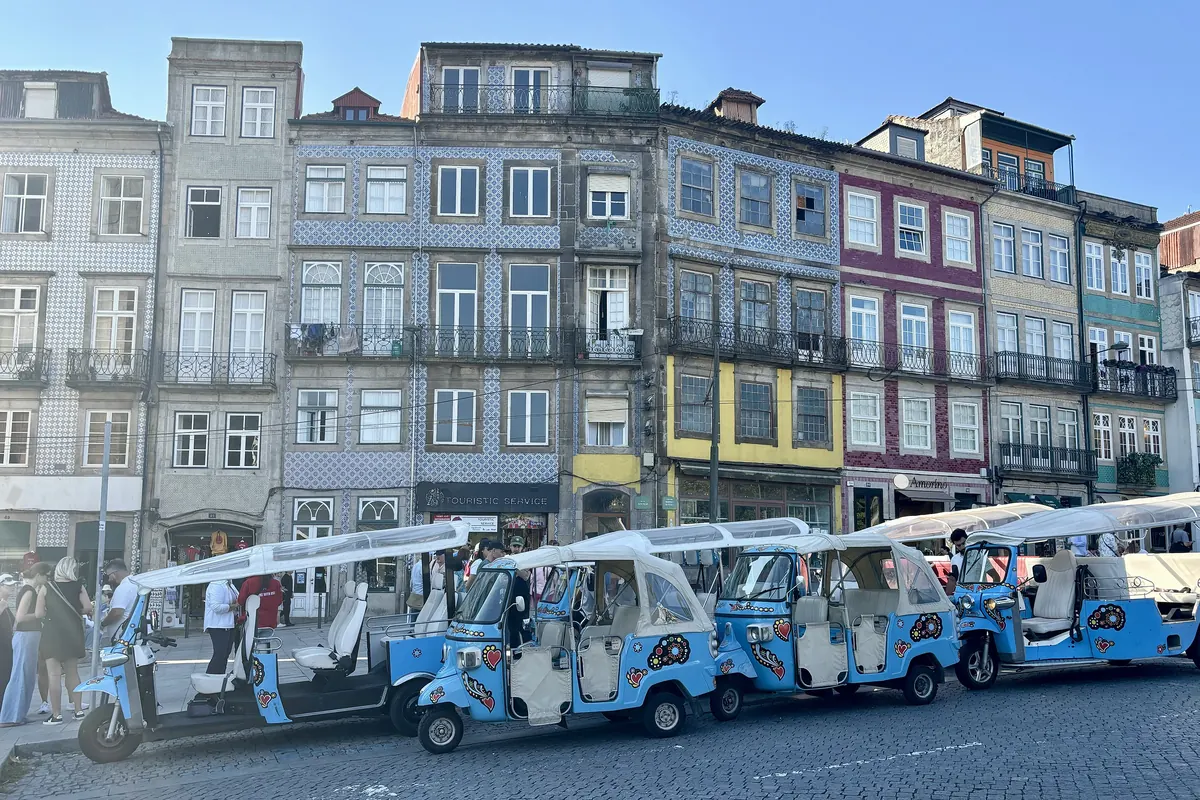
An electric tuk-tuk takes you through the historic centre with a live guide, past the outside of São Bento station, Porto Cathedral and the Clérigos tower, down the Avenida dos Aliados and past the Lello bookshop to the banks of the Douro, then on by the Stock Exchange Palace and Miragaia. The ride takes about 50 minutes. Shared and private versions exist, and in the shared one a single booking may be split across more than one tuk-tuk. The guide works in English, French, Spanish or Portuguese, and a voucher for a Porto walking tour the following day comes with it.
The river part, and when it runs
The optional cruise is a separate 55-minute trip on a rabelo, the traditional Douro cargo boat, under the six bridges that link Porto and Vila Nova de Gaia. Your tuk-tuk guide hands you an open ticket, so you can sail on the day and at the time that suits you without booking ahead. The cruise sails only in daytime hours, which are shorter from October to March, and that is why the full tuk-tuk-and-river version is an afternoon plan. All told it takes about 105 minutes, ride and cruise together.
What the fado concert is
The fado ticket buys sixty minutes of live song in a small room near the Cordoaria garden, in two parts, with a man and a woman singing to a Portuguese guitar and a classical guitar. A glass of Portuguese wine is included, the history of fado is explained briefly at the end in four languages, and the musicians stay afterwards to talk. It is seated and quiet, and it asks you to listen rather than look around. Start times vary by date and appear in the booking calendar.
Seeing Porto against hearing it
The tuk-tuk gives you the city’s set pieces in under an hour: the azulejo-tiled hall of São Bento, the Baroque church and tower of the Clérigos, the riverfront that sits inside the UNESCO-listed historic centre. Its value is orientation and a guide who can answer questions as you go. The fado gives you something you cannot see from a seat in a moving vehicle: a tradition UNESCO inscribed in 2011, sung in a small acoustic room. Neither replaces the other, and each makes the other richer if you do both.
How much you will learn
The tuk-tuk is the better teacher of the city. A live guide talks you through the old centre as you go, in English, French, Spanish or Portuguese, and you can ask questions about whatever catches your eye. The fado concert teaches you about the music, but mostly by letting you hear it: the songs are in Portuguese and are not explained one by one, and the history of fado gets only a short talk at the end, in the same four languages. If you want the background before the concert, the listening and history guides on this site cover it in a few minutes each.
Price and what is included
Both are modestly priced next to most Porto tours; the live price for each sits in its calendar. What the money buys differs. The fado ticket includes the concert and a glass of wine, but no food and no transport. The tuk-tuk includes the ride and guide, the river cruise only if you pick that option, and the walking-tour voucher, while food, drinks and tips are not included. Neither involves a pickup, so plan to walk to each meeting point.
Access, bags and children
Neither suits wheelchair users. The tuk-tuk is also not recommended for pregnant travellers, visually impaired people or anyone with a pre-existing medical condition, and it does not allow pets, baby strollers or bags. The fado concert does not admit children under six and takes place in an old building with steps. If you travel with a pushchair, the fado is the easier of the two once the child is old enough to sit still for an hour.
Who should pick which
Most travellers fall into one of a few simple cases. Choose by what you came for, not by price, since both cost little next to a full-day trip out of the city. If your group is split, there is no rule that says you must all do the same thing: the sightseers can ride in the afternoon while the music lovers rest, and everyone meets again for dinner.
- First time in Porto, one free afternoon: the tuk-tuk with the cruise.
- One free evening and an interest in music: the fado concert.
- Travelling with children under six: the tuk-tuk, if no stroller is needed.
- Hills are hard for you: the tuk-tuk spares your legs, the fado needs steps.
Doing both in one day
The neatest plan is the tuk-tuk in the afternoon, the river cruise straight after it while the boats are running, an early dinner in the Baixa, and then the fado. The ride passes the Clérigos tower, so you will already know your way back to the meeting point near the Cordoaria garden. Check the start time of your concert in the calendar before you book the afternoon, and leave room for the climb back up from the river. On a shorter visit, flip the order across two days instead: the tuk-tuk on your first afternoon to learn the layout of the city, and the fado on your last evening, when you know your way around and can walk to the Cordoaria without a map.
Who this isn’t for
This comparison does not help if you want a meal with your fado or a sunset on the water; neither ticket offers those. Visitors short on stamina should know that the fado concert involves steps, while the tuk-tuk excludes several groups for medical reasons. If none of you fits either, a daytime walk past the same sights at your own pace costs nothing.
Read next: Is this Porto fado hour worth it?
Frequently asked questions
Can I do the tuk-tuk and the fado on the same day?
Yes, and they fit well together: the tuk-tuk and its river cruise in the afternoon, since the cruise sails in daytime hours, and the fado concert after dinner. Check your concert’s start time before booking the afternoon.
Which is better for a first visit?
For seeing the city, the tuk-tuk: in about 50 minutes it passes the cathedral, São Bento, the Clérigos tower and the riverfront. For hearing Portugal’s best-known music, the fado. With one free slot, choose by which matters more to you.
Is the river cruise included with the tuk-tuk?
Only if you pick the option that includes it. You then receive an open ticket and can sail when it suits you during daytime hours.
Which one is easier with mobility issues?
Neither suits wheelchair users. The tuk-tuk saves walking up Porto’s hills, while the fado concert is in an old building with steps.
Can I cancel either?
Yes. Booked through GetYourGuide, either one comes back as a full refund when called off a day or more before its start, and both let you hold the place first and pay later.
Sources